
 Ravdeep Roewal, Founder
The short answer
You can outsource most repeatable, screen-based work to India, from bookkeeping, credit control and admin to data entry, email and chat support, lead generation, digital marketing and ecommerce operations. What you should keep in the UK is strategy, final sign-off, regulated advice and your most important client relationships.
If your team’s stretched and that job ad has drawn a handful of so-so applicants, you’re not alone. The real question isn’t whether a whole department can move, but which tasks inside it can.
Key takeaways
- Outsource the process, keep the decision. Preparation, processing and first-line replies move well; approvals, pricing and regulated advice stay with you.
- Choose the model before the function. A managed service, dedicated staff through a provider and hiring directly each put control, risk and employment duties in different places.
- India has no UK adequacy decision, so staff there who can see personal data usually need an IDTA or the UK Addendum, a transfer risk assessment and an Article 28 contract.
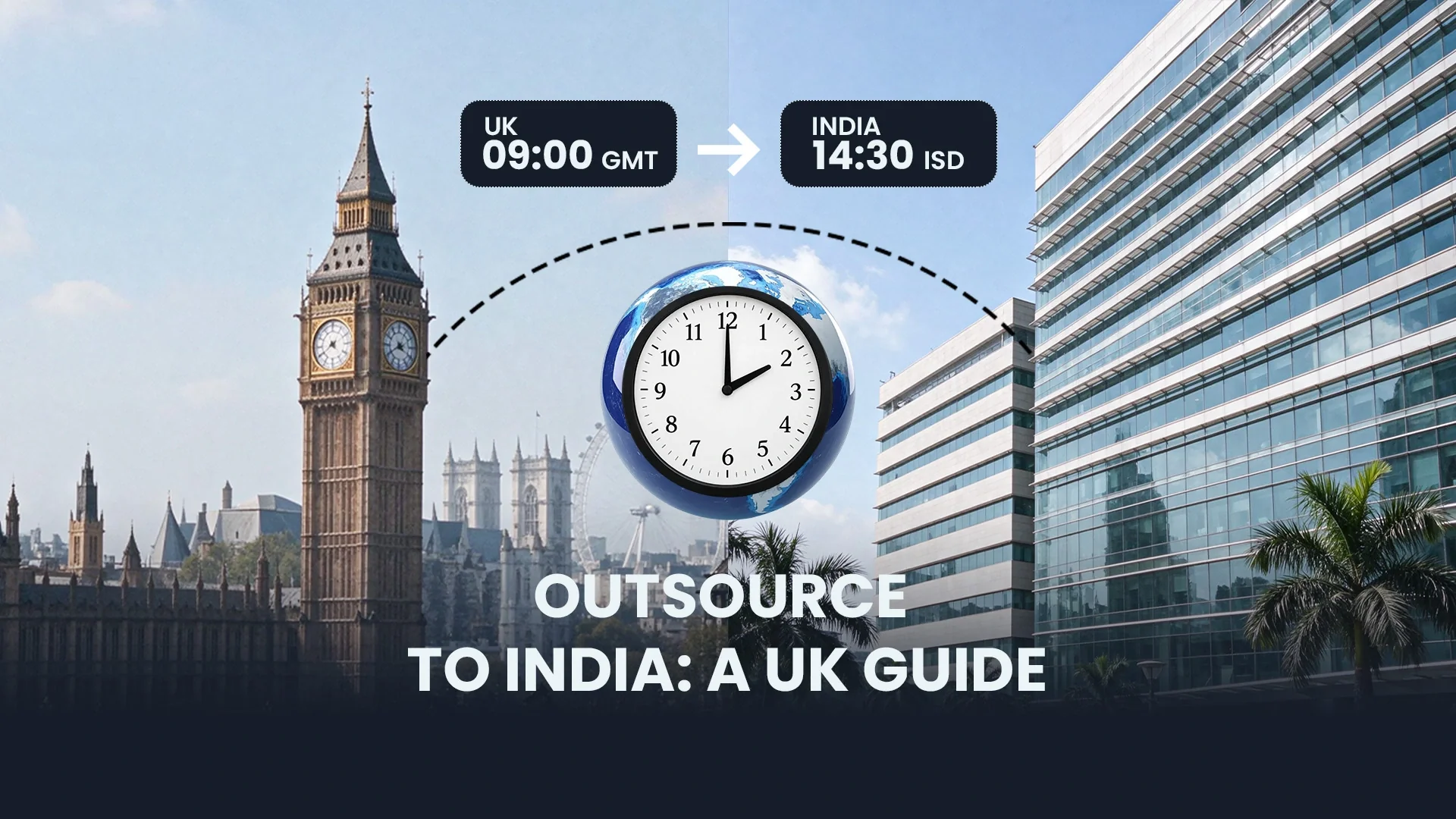
- India is 5 hours 30 minutes ahead of the UK in winter and 4 hours 30 minutes ahead in summer, so a late Indian shift can cover the full UK working day.
- Dedicated staff through Aspire Offshore start from £650 a month, with savings typically between 62% and 70% against a comparable UK hire, and up to 80% for some roles.
- Start with one well-documented role, measure it for 90 days, then expand.
What does outsourcing to India mean for a UK business?
Put simply, it means paying a provider or people in India to do work you’d otherwise do in-house. There are three ways to do it, and which you pick matters more than the country. (BPO, below, is short for business process outsourcing.)
| Model | Who directs daily work | Who employs the staff | Best for | Watch out for |
|---|---|---|---|---|
| Managed service (traditional outsourcing or BPO) | The provider, against a service agreement | The provider | A defined process with clear output, such as invoice processing or overflow support | Shared staff, less visibility, change requests cost extra |
| Dedicated staff through a provider | You | The provider or its partner in India | Ongoing roles that need to learn your systems and work your hours | You still need documented processes and a manager’s time |
| Direct hire or employer of record | You | You, or an employer-of-record company | Larger teams or specialist hires | Indian employment law, payroll and tax obligations, and permanent establishment questions |
If you’re torn between the first two, our guide to the difference between outsourcing and offshoring explains who holds the knowledge and risk in each. We work on the second model, providing a dedicated offshore team or a team extension whose staff work only for you. An employer of record is a company that legally employs staff for you abroad.
Which business functions can you outsource to India?
Most office functions have a big chunk that can move. Here’s the overview.
| Function | Typical tasks that move | What to keep in the UK | Roles that do the work | Suitability |
|---|---|---|---|---|
| Finance and accounting | Bank reconciliations, purchase and sales ledgers, VAT return preparation, month-end schedules, invoice chasing | Sign-off, tax advice, filing authority, payment approval | Bookkeeper, accountant, finance assistant, credit controller | High |
| Admin and executive support | Inbox and diary management, document preparation, research, travel booking, CRM updates | Decisions made in your name, sensitive HR matters | Virtual assistant, executive assistant, office or business administrator | High |
| Data and back office | Data entry, document processing, catalogue updates, report building, data cleansing | Deciding what the data is used for | Data entry specialist, operations administrator, CRM administrator | High |
| Customer support | Email and ticket replies, live chat, order and returns queries, complaint logging | Escalations, refunds above a limit, vulnerable customers | Customer service agent, live chat agent | Medium to high |
| Sales support | Prospect research, list building, appointment setting, outbound calls, sales admin | Pricing, negotiation, closing key accounts | Lead generation specialist, appointment setter, telesales executive, sales administrator | Medium |
| Digital marketing and creative | SEO, paid search, social media scheduling, content drafts, design, video editing | Brand positioning, final approval, budget decisions | SEO specialist, PPC specialist, content writer, graphic designer, video editor | High |
| Ecommerce operations | Listings, stock and price updates, marketplace messages, order admin | Supplier relationships, pricing strategy | Marketplace specialist | High |
| HR and recruitment admin | CV screening, interview scheduling, onboarding paperwork, HR records | Hiring decisions, disciplinaries, grievances | HR or recruitment administrator | Medium |
| IT and software | Development, testing, helpdesk, monitoring | Architecture decisions, security ownership | Developers, testers, support engineers | High, but specialist |
Finance and accounting
Picture month-end: your finance team’s up late and nobody’s chased the overdue invoices. That work travels well, because it’s rule-based and easy to check.
An offshore bookkeeper can keep Xero, QuickBooks or Sage up to date, reconcile bank feeds and prepare records for your accountant. Experienced offshore accountants can prepare management accounts and month-end journals for review.
Chasing payments suits offshore staff too. A dedicated credit controller can send statements, chase overdue invoices and log disputes, while you decide when to stop supply. A good one is worth their weight in gold.
Keep sign-off and tax judgement in the UK, though. Making Tax Digital (HMRC’s move to digital records and quarterly updates) is adding a fair bit of work: HMRC’s guidance says sole traders and landlords with qualifying income over £50,000 should have started using MTD for Income Tax from 6 April 2026, with the threshold falling to £30,000 from April 2027 and £20,000 from April 2028. Those updates can be prepared offshore and checked here.
Admin and executive support
Routine emails, diaries, paperwork and spreadsheets are a real faff when they all land on you, and all of it can be done remotely once access and ground rules are clear.
The British Business Bank lists administration among the functions smaller firms commonly outsource, usually to a virtual assistant. For someone on your hours every day, you can hire a virtual assistant dedicated to your business, working in your own Microsoft 365, Teams or Slack. For senior diaries and board papers, a remote executive assistant is the better fit.
Data entry and back-office processing
Data work is high volume and easy to spot-check, so it’s one of the lowest-risk places to start.
If you plan to outsource data entry, agree an accuracy target and a checking routine from day one. A weekly spot-check catches problems before they snowball.
Customer support
You know the feeling: the helpdesk (where customer emails and tickets land) fills up over the weekend and Monday vanishes. It moves well with a knowledge base, clear refund limits and someone to escalate to. Email and ticket support can cover orders, returns and account changes, and a live chat agent can answer website visitors during your UK hours.
Keep complex complaints, vulnerable customers and goodwill decisions with someone in the UK, at least until the team has proved itself.
Sales and lead generation
Many firms start by asking a lead generation specialist to qualify accounts, then bring in someone to outsource appointment setting once they know the pitch works.
Calls into the UK follow UK rules, wherever the caller sits. The ICO’s telephone marketing guidance says you must screen live marketing calls against the TPS (the Telephone Preference Service, the UK’s opt-out list for sales calls) and the Corporate TPS, and keep your own do-not-call list. Pricing and closing key deals should stay here.
Digital marketing, content and design
An offshore SEO specialist can handle technical fixes, on-page updates and reporting. PPC (pay-per-click ads, such as Google Ads), social scheduling, design and video editing work the same way. It’s a good place to get bang for your buck, because you can see the results.
Keep brand positioning and final approval in the UK, and give writers a British English style guide.
Ecommerce and marketplace operations
Selling online means hours on listings, stock updates, marketplace messages and order admin. A marketplace specialist can keep Amazon and your other channels current while you get on with suppliers and margins.
HR, recruitment admin and IT
Recruitment admin, like screening CVs and booking interviews, moves easily. Hiring decisions, disciplinaries and grievances don’t. IT support and software development also outsource well, but they need specialist vetting.
What should a UK business not outsource to India?
Keep work in the UK when it sets direction, carries personal legal responsibility or relies on face-to-face trust. For most firms, that’s:
- Strategy, pricing and budget decisions.
- Final sign-off on accounts, tax returns and regulatory filings.
- Approval of payments and changes to supplier bank details.
- Regulated advice, such as financial, legal or tax advice to clients.
- Hiring, dismissal and disciplinary decisions.
- Your most valuable client and supplier relationships.
- Anything you cannot yet describe in a written process.
The prep work can still move. An offshore accountant can prepare the VAT workings or the year-end pack for your Companies House filing; your accountant checks and submits.
How do you decide which tasks to outsource first?
Start with the task that comes round often, is written down and is easy to check. Ask:
| Question | Good sign | Warning sign |
|---|---|---|
| How often does it happen? | Daily or weekly | A few times a year |
| Is there a written process? | Yes, or it can be written in a day | It lives in one person’s head |
| Can you check the output? | Clear accuracy or response targets | Quality is a matter of opinion |
| How much judgement does it need? | Rules cover most cases | Every case is different |
| What data does it touch? | Business records or limited personal data | Health, financial or children’s data |
| What happens if it goes wrong? | Easy to correct | Regulatory breach or lost client |
Then crack on:
- 1List the tasks your team repeats each week and the hours they take.
- 2Score each task against the questions above.
- 3Write or record the process for the top two or three tasks.
- 4Decide the model, the access each person needs and who in the UK manages them.
- 5Run a 90-day trial with agreed measures, such as turnaround, accuracy and backlog.
- 6Expand only once the first role is working.
The elephant in the room
Not every offshore hire works out. On r/Accounting, people managing teams in India say routine work runs smoothly but unexpected cases trip people up, so give expected ranges and spell instructions out. On r/smallbusinessuk, owners say written English varies and recommend a trial period. Documentation, a named UK manager, staged access and early feedback head off most of this.
What does outsourcing to India cost compared with a UK hire?
If you’ve hired in the UK recently, you’ll know the salary is only part of the bill. For 2026 to 2027, HMRC’s rates and thresholds set employer National Insurance at 15% on earnings above £5,000 a year, though eligible employers can claim an Employment Allowance of up to £10,500. Most workers are also entitled to 5.6 weeks of paid holiday, and you’ll usually pay pension contributions, recruitment, equipment and desk space on top.
| Cost item | UK employee | Dedicated staff through a provider | Managed service |
|---|---|---|---|
| Salary or fee | Salary | Monthly fee per person, from £650 a month with Aspire Offshore | Per hour, per transaction or per month |
| Employer NI and pension | Paid by you | Not included in the from-£650 fee; Indian statutory employer costs are charged on top, so ask for a full quote | Not applicable |
| Recruitment | Agency fee or your time | Handled by the provider; with Aspire, hiring and onboarding take 4 weeks | Not applicable |
| Holiday and sickness cover | You arrange it | Each team member builds up 1.5 days’ paid leave a month. Leave beyond that balance is unpaid and the day’s salary is deducted, so you don’t pay for it. In genuine emergencies, they get full salary | Provider’s responsibility |
| Office, IT and equipment | You provide | Office, equipment and support provided by Aspire | Provider’s responsibility |
| Management time | Yours | Yours, for daily direction | Mostly the provider’s |
Dedicated staff from
£650/moper person with Aspire Offshore
Typical saving
62–70%against a comparable UK hire, up to 80% for some roles
Hiring and onboarding
4 weekswith a 4-week replacement guarantee
With us, savings are typically 62% to 70% against a comparable UK hire, and up to 80% for some roles, depending on the role. To run the numbers, try the offshore cost calculator and check the assumptions behind it.
Is outsourcing to India legal, and what about UK GDPR?
Yes, it’s legal, but you’ll need to follow UK data protection rules whenever staff in India can see personal data. The ICO’s guide to international transfers explains when a “restricted transfer” happens. India doesn’t have a UK adequacy decision (the UK’s formal finding that a country’s data laws are up to standard), so you’ll normally need an International Data Transfer Agreement or the UK Addendum (standard contract clauses) and a transfer risk assessment. Remote access counts too, even if data never leaves UK servers.
Get this checklist sorted before anyone logs in. Article 28 is the part of UK GDPR covering contracts with anyone handling personal data for you; SYSC 8 is the FCA’s outsourcing rulebook for regulated firms.
| Area | What to check | Source |
|---|---|---|
| Processor contract | The contract covers the Article 28 terms: documented instructions, confidentiality, security, sub-processors, deletion at the end and audits | ICO contract guidance |
| International transfer | IDTA or UK Addendum signed, transfer risk assessment on file | ICO international transfers guidance |
| Access control | Named logins, least-privilege access, multi-factor authentication, no shared passwords | Your security policy |
| Marketing calls | TPS and Corporate TPS screening and a do-not-call list | ICO telephone marketing guidance |
| Regulated firms | Outsourcing of important functions meets FCA systems and controls rules | FCA Handbook SYSC 8 |
| Indian law | The provider follows India’s labour codes, in force since 21 November 2025, and the Digital Personal Data Protection Act 2023 | PIB labour codes notice, MeitY DPDP Rules |
| Contractor status | If you engage individuals directly, take advice on employment status; the UK off-payroll working rules (IR35) are designed for contractors working through their own intermediary | GOV.UK |
India’s Digital Personal Data Protection Rules were notified on 13 November 2025 and come in by phases, with the main duties, including security safeguards and breach notification, applying from 13 May 2027. Ask any provider how it’s preparing. IR35 is the set of rules on whether a contractor should really be treated as an employee. If you’re thinking of employing people there yourself, our guide to employing staff overseas sets out the options.
Can staff in India work UK hours?
Yes. India Standard Time is UTC+5:30 and doesn’t change in summer, so staff can work a later shift that matches your day. UK clocks go forward on the last Sunday in March and back on the last Sunday in October, according to GOV.UK.
| UK working day | India time, late October to late March (GMT) | India time, late March to late October (BST) |
|---|---|---|
| 09:00 start | 14:30 | 13:30 |
| 13:00 | 18:30 | 17:30 |
| 17:30 finish | 23:00 | 22:00 |
Agree the shift pattern, including clock changes, before you recruit so everyone’s on the same page.
Where would your Aspire Offshore team work?
Your staff work full time, only for you, from our managed office at Bestech Business Tower, B-207, Parkview Residence Colony, Sector 66, Sahibzada Ajit Singh Nagar, Punjab 160062, India. They work your agreed UK hours, use your systems and take their day-to-day direction from your team, while we handle recruitment, the office and HR support. We’ve hired more than 300 experts across over 30 UK businesses, typically 10 to 15 per business, and hiring and onboarding take 4 weeks. If a hire isn’t the right fit, our 4-week replacement guarantee applies.
Two clients put it this way on our website:
“Aspire Offshore transformed our back-office operations. We now have a team of 8 accountants in India who work UK hours, and our costs are down 65%. Exceptional service from day one.”
Nicola Carswell, CFO, Furdeco
“Our SEO and PPC team based in India through Aspire Offshore have delivered incredible ROI. They operate on UK time, use our tools, and feel like part of our team.”
Michael Barnes, Director, Workwear Uniform Group
How to choose a partner in India
Ask any provider for evidence, not promises: certificate details for any security standard they claim, sample contracts, UK client references and who actually employs the staff. For the record, Aspire Offshore is ISO 27001 certified (the international standard for information security). Our checklist on how to choose an offshore staffing company goes deeper.
Not sure which role fits? Browse the offshore roles UK businesses hire for or book a free consultation and we’ll talk it through.