
 Ravdeep Roewal, Founder
UK business owners spend about 10 hours a week on accounting tasks, according to a YouGov survey reported by TaxAssist. That’s bookkeeping, admin and tax returns. As a business grows, that figure rarely shrinks. So the question is who you hand the work to.
The short answer
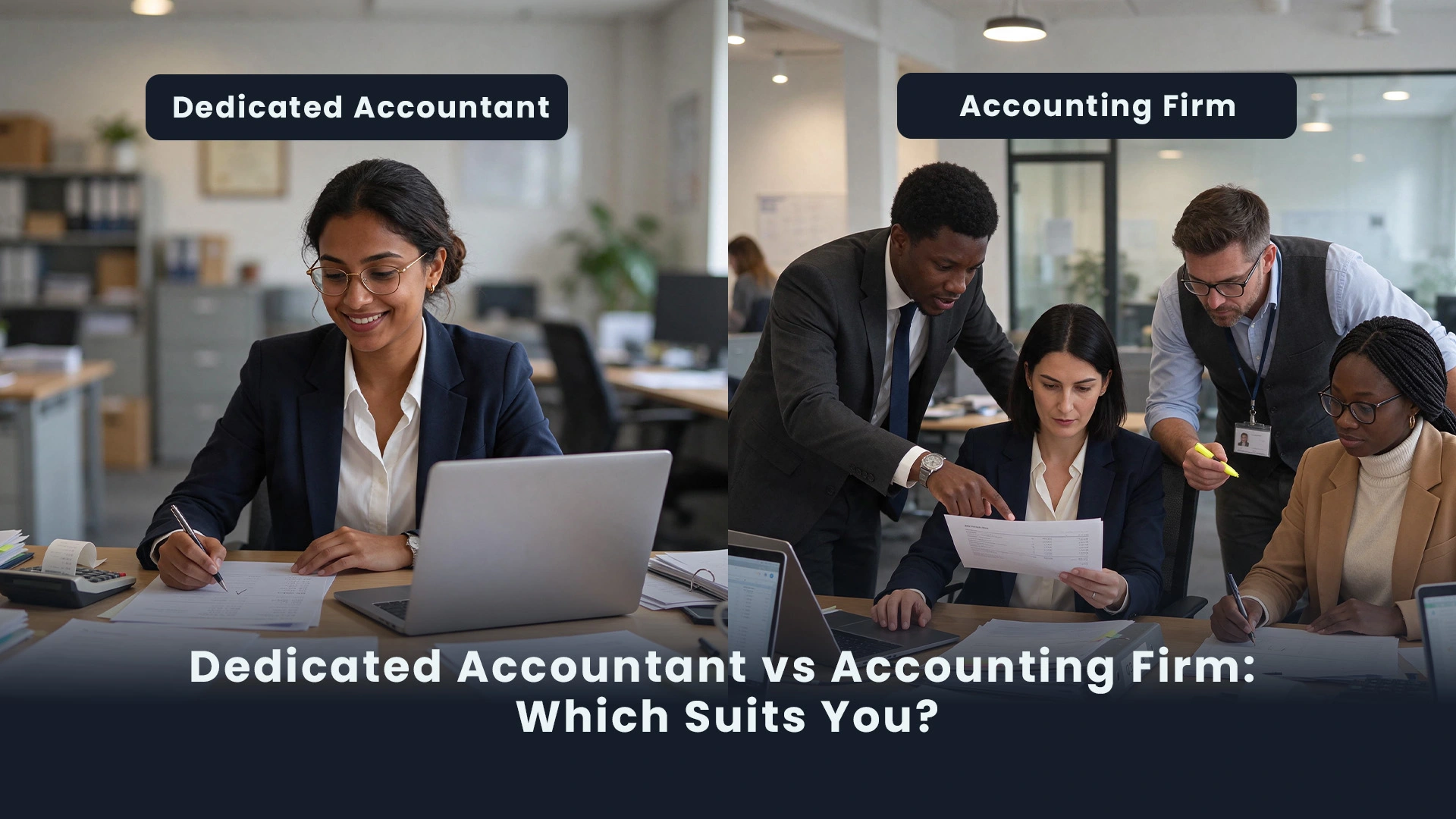
An accounting firm suits you if your needs are mostly yearly, such as accounts, tax returns and the odd question. But if there’s finance work every day, you’ll get more from a dedicated accountant who knows your numbers and works your way. Many growing businesses end up using both.
This guide looks at the accounting firm vs in-house accountant choice. It also covers a third route that most comparisons skip: one accountant who works only for you but isn’t on your payroll. If that sounds like what you need, see how having one accountant work only on your business works. You can also find out how to hire an accountant who works only for you.
Key Takeaways
| Question | Short answer |
|---|---|
| In-house accountant or accounting firm? | A firm for yearly compliance; your own accountant for daily finance work |
| Who should use an accounting firm? | Businesses that mainly need year-end accounts, tax returns and occasional advice |
| Who needs a dedicated or in-house accountant? | Businesses with daily transactions, monthly reporting and quick decisions to make |
| Biggest difference | A firm splits its people across many clients; a dedicated accountant works on your books alone |
| Can you use both? | Yes. Many businesses use their own accountant day to day and a firm for year-end and tax |
| One risk to avoid | One person recording, approving and paying with nobody checking |
Your 3 Options: Accounting Firm, In-House Accountant or Dedicated Accountant
Most comparisons give you two choices. There are actually three.
- 1An accounting firm. Your work sits alongside dozens of other clients. You agree a package and the firm decides who does it and when.
- 2An in-house accountant. They’re on your payroll. They work your hours and report to you, and you take on all the costs and duties of being their employer.
- 3A dedicated accountant through a provider. This is somewhere in the middle. One named person works only on your business, in your software, during your hours. The provider deals with hiring, HR and cover, so you don’t employ them.
You don’t have to use any of these. Xero’s guide notes there’s no legal requirement to hire an accountant in the UK. But once the books get busy, doing them yourself tends to cost more than it saves.
Accounting Firm: Pros and Cons
So who needs an accounting firm? Mostly businesses where the finance work comes in a few big bursts each year.
What a firm does well
A decent firm has tax specialists, auditors and advisers on staff. You’d never afford that range yourself. Year-end accounts, Corporation Tax and Self Assessment are their everyday work, so they’re quick at it. You also skip the hiring, the holiday rota and the appraisals.
Size matters too. The Companies House blog suggests picking a firm that matches your business. A micro company might be happy with a small local practice, while a start-up growing fast may need a bigger one.
Where firms fall short
- Your accounts are one file in a big pile. In January, when Self Assessment deadlines hit, every client wants attention at once.
- The person can change. Firms often work in teams, so whoever posts your transactions this year might have moved on by next year.
- Anything outside the package usually costs extra. A “quick question” can end up on the bill.
- The firm sets the timetable, and sometimes the software. That leaves you with less of a view of your numbers day to day.
In-House Accountant: Pros and Cons
Why owners like having their own accountant
When it comes to in-house accountant vs accounting firm, the in-house side wins on knowledge. Your own accountant learns the business properly. They’ll spot a supplier invoice that looks off. Ask for your cash position at 10am and you’ll have it by lunch. And you decide what they work on first.
The downsides
An employee costs a lot more than their salary. Our breakdown of what outsourcing accounting really costs shows how National Insurance, pension and recruitment fees stack up. Finding the right person isn’t quick either, and the UK accountant shortage can drag a search out for months. When they’re off sick or on holiday, the work just waits. Also, one person can’t know everything, so you’ll probably still pay a firm for specialist tax advice.
Where a Dedicated Accountant Fits
A dedicated accountant from a provider gives you most of what’s good about in-house. It’s one person, on your books only, who gets to know how you run things. The difference is that hiring, HR and cover are the provider’s job, not yours.
The catch is that they’re remote. That works well with clear processes and someone in the UK reviewing their work. Without those, it’s harder. So the dedicated accountant vs accounting firm decision usually comes down to how much day-to-day finance work you’ve got.
Accounting Firm vs In-House Accountant: Side-by-Side
Still asking yourself, “Should I hire an accountant or use an accounting firm?” Here’s the accounting firm vs in-house accountant choice, with the dedicated route added.
| Factor | Accounting firm | In-house accountant | Dedicated accountant |
|---|---|---|---|
| Who does your work | A shared team | Your employee | One named person |
| Works only on your business | No | Yes | Yes |
| Whose software | Often the firm’s | Yours | Yours |
| Who sets priorities | The firm’s workflow | You | You |
| Day-to-day availability | Limited | Full | Full, on your hours |
| Continuity | Staff may rotate | Depends on retention | Same person; provider replaces if needed |
| Holiday and sickness cover | Firm covers it | Your problem | Provider arranges it |
| Specialist tax advice | Strong | Limited | Limited |
A firm comes out ahead on expertise and convenience. Your own accountant, employed or dedicated, comes out ahead on attention and control.
5 Signs Your Business Has Outgrown Its Accountant
The finance side is often where growing pains show first. If a couple of these ring true, you’ve probably outgrown your accountant:
- 1Your books only get updated at year-end. That means decisions get made without this month’s figures.
- 2You still do the bookkeeping yourself. Plenty of owners do. A NerdWallet UK survey found 29% of business owners pay an accountant for tax returns and handle everything else on their own.
- 3Basic questions take days to answer. If it takes a week to find out who owes you money, something’s wrong.
- 4You need monthly management accounts. Banks, investors and your own planning will start asking for them.
- 5VAT, payroll and month-end keep landing at once. When deadlines stack up, things slip.
That doesn’t make your firm a bad one. It usually just means the work has changed from a once-a-year job into a daily one.
When to Hire an In-House Accountant
A good rule: bring in your own accountant, employed or dedicated, when the finance work fills most of a week. Common triggers are:
- purchase and sales invoices to process and reconcile every day
- monthly reports, budgets or cash-flow forecasts
- more than one bank account, company or currency
- a payroll that changes from month to month
If the work is lumpy, a firm is usually enough. Take a consultancy billing ten clients a month. It doesn’t need a full-time accountant. An online shop processing hundreds of orders a day almost certainly does.
Separation of Duties: Why One Accountant Alone Is a Risk
Few owners think about this until it bites. If one person posts the transactions, approves the payments and reconciles the bank, nobody’s checking them. Honest mistakes slip through, and so can dishonest ones.
The answer: separation of duties
It simply means splitting the jobs up. One person prepares and another approves. In a small business, that’s often you signing off payments, with a second reviewer for VAT returns and month-end. With a dedicated accountant, you keep your own logins and the final say, so the control stays with you.
Our guide to building an offshore accounting team goes through how to set up these checks.
Can You Use an Accounting Firm and an In-House Accountant Together?
Yes, and for a lot of growing businesses it’s the best setup. Using an accounting firm and an in-house accountant together gets you daily control plus specialist knowledge. Crowe points out that some businesses run a small internal team and call on a firm for specialist work, reporting, compliance or extra help at busy times.
The split usually looks something like this. Your own accountant (in-house or dedicated) covers bookkeeping, reconciliations, VAT preparation, payroll and month-end. The firm covers year-end accounts, Corporation Tax, tax planning and advice on bigger decisions.
There’s a bonus, too. The firm’s bill often drops because it’s working from clean, reconciled books, not a year’s worth of catch-up.
What About a Part-Time Accountant?
Part-time works if you’ve got two or three days of finance work a week rather than five. The risk is timing. If something urgent comes up on their day off, it waits. If the work is mainly admin, a finance assistant or a dedicated bookkeeper might cover it, with your firm doing the technical side.
Frequently asked questions
Next Step: Match the Model to Your Workload
Write down the finance tasks your business handles in a typical month. Mark which happen daily and which happen once a year. If most of it is yearly, a firm fits. If it’s daily, you need your own accountant. If it’s a mix, use both. That’s the simplest way to settle the accounting firm vs in-house accountant question.
Need someone on your books every day? See how our outsourced accounting gives you one accountant who works only for your business, on UK hours. Or book a free consultation and we’ll help you work out which setup fits.